Roll-Up Sign Compatibility Guide: Choosing the Right Sign Stand Attachment for Maximum Safety and Performance
Published by CPC Signs on Aug 3rd 2026
When it comes to temporary traffic control, utility work zones, municipal projects, and roadway maintenance, choosing the correct roll-up sign is only half the equation. Equally important is ensuring that your roll-up sign attachment is compatible with your sign stand. Using the wrong attachment can lead to installation issues, reduced performance, and unnecessary replacement costs.
The compatibility chart from CPC Signs highlights one of the most common questions customers ask:
"Are your roll-up signs and sign stand attachments compatible?"
Understanding the difference between Auto-Latch, Universal Attachments, Hard Plastic Pockets, and Sewn Pockets can save time, money, and frustration in the field.
Understanding Roll-Up Sign Attachments
Roll-up signs are designed to work with portable sign stands and fiberglass ribs to create a highly visible, MUTCD-compliant temporary traffic control system. However, not all sign stands use the same attachment mechanism.
There are two primary attachment styles:
1. Auto-Latch Attachments
Auto-latch sign stands feature a specialized locking mechanism that automatically secures the sign ribs into place.
Benefits include:
- Faster deployment
- Consistent sign positioning
- Reduced setup errors
- Quick removal when work is completed
However, there is an important compatibility requirement:
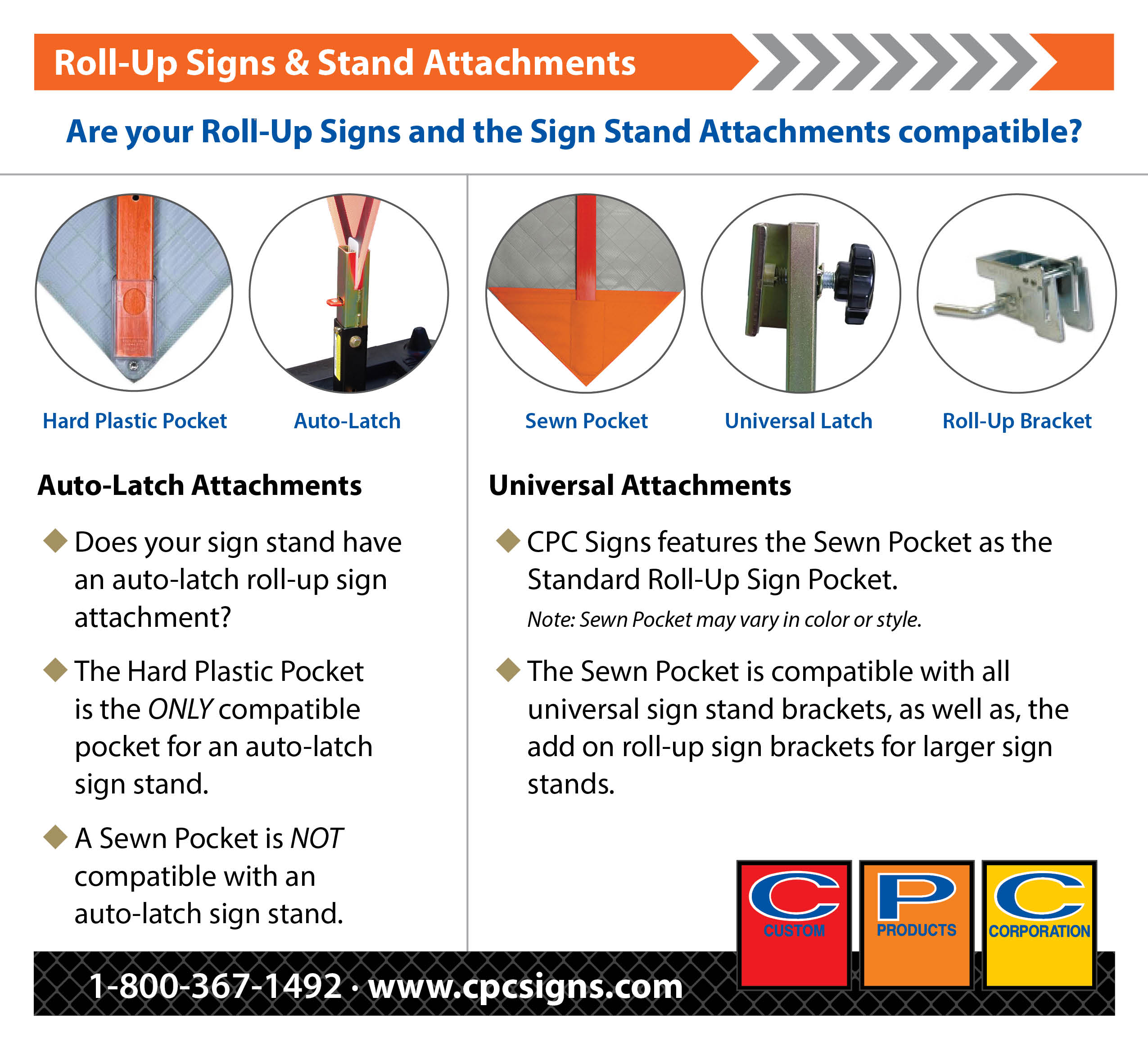
✅ Auto-latch systems require Hard Plastic Pockets
❌ Auto-latch systems are NOT compatible with sewn pockets
According to CPC Signs, the Hard Plastic Pocket is the only compatible pocket style for an auto-latch sign stand.
If your current stand uses an auto-latch system, you must ensure that replacement roll-up signs are ordered with the appropriate hard plastic pocket configuration.
Browse CPC's roll-up signage options here: https://www.cpcsigns.com/roll-up-signs/
What Is a Hard Plastic Pocket?
A hard plastic pocket is a reinforced pocket permanently attached to the back of the roll-up sign.
These pockets:
- Allow secure connection with auto-latch stands
- Provide precise rib placement
- Improve deployment speed
- Reduce wear at attachment points
For organizations operating multiple auto-latch stands, maintaining consistency with hard plastic pockets helps eliminate compatibility issues across fleets of equipment.
Typical users include:
- State DOTs
- Utility contractors
- Traffic control companies
- Municipal public works departments
- Road maintenance crews
Universal Attachments: The Flexible Solution
For many organizations, flexibility is key.
Universal attachment systems accommodate a wider variety of stands and applications.
CPC Signs uses a Sewn Pocket as the standard roll-up sign pocket for universal compatibility.
Advantages include:
- Broad stand compatibility
- Easy replacement
- Cost-effective deployment
- Compatible with most universal brackets
Unlike auto-latch configurations, sewn pockets work with nearly all universal sign stand brackets and many add-on roll-up brackets used on larger sign stands.
What Is a Sewn Pocket?
A sewn pocket is a reinforced fabric pocket stitched directly into the sign material.
Benefits include:
- Lightweight design
- Flexible installation
- Universal compatibility
- Proven field performance
At CPC Signs, sewn pockets are the standard pocket type for many roll-up sign systems because they work with a wide range of stand configurations.
Explore CPC's selection of roll-up traffic control signs:
https://www.cpcsigns.com/roll-up-signs-for-temporary-traffic-control/
Choosing the Correct Sign Stand
Before ordering replacement signs, ask yourself the following questions:
Does Your Existing Stand Use Auto-Latch Technology?
If yes:
- Order roll-up signs with Hard Plastic Pockets
- Verify stand model compatibility
- Avoid sewn-pocket configurations
Does Your Existing Stand Use Universal Brackets?
If yes:
- Sewn Pocket signs are generally recommended
- Universal brackets accommodate many sign styles
- Easier to standardize across multiple stand types
Popular Roll-Up Sign Stands from CPC Signs
Standard Compact Non-Wind Deflectable Sign Stand
The CPC Signs Standard Compact Sign Stand is a popular option for low-volume roadways and utility applications.
Key features include:
- Designed for 36-inch roll-up signs
- Available with Auto-Latch or Universal Bracket attachments
- Compact storage footprint
- Telescoping legs
- Adjustable positioning on uneven terrain
Product link:
https://www.cpcsigns.com/standard-compact-non-wind-deflectable-sign-stand/
This product illustrates exactly why attachment selection matters. Customers can choose either:
- Auto-Latch compatibility
- Universal Bracket compatibility
Choosing the wrong roll-up sign pocket configuration may prevent proper installation.
Why Compatibility Matters
Traffic control equipment is often purchased over many years by different departments or project managers.
As a result, organizations may unknowingly end up with:
- Multiple stand models
- Various attachment styles
- Different roll-up sign pocket configurations
Without standardization, crews may discover in the field that:
- Signs will not mount properly
- Hardware is missing
- Setup takes longer
- Compliance may be impacted
A quick compatibility review before ordering new signs can eliminate these issues.
Building a Complete Traffic Control System
An effective temporary traffic control setup includes more than just signs.
Many CPC Signs customers combine:
Roll-Up Signs
https://www.cpcsigns.com/roll-up-signs/
Sign Stands
https://www.cpcsigns.com/safety-products/rigid-roll-up-sign-stands/
Fiberglass Ribs
https://www.cpcsigns.com/
Traffic Cones
https://www.cpcsigns.com/traffic-cones/
Delineators and Channelizers
https://www.cpcsigns.com/channelizers-delineators/
Sign Hardware and Brackets
https://www.cpcsigns.com/posts-brackets-hardware/
Using compatible components throughout the system improves deployment efficiency and creates a more reliable work zone.
Best Practices When Ordering Replacement Roll-Up Signs
Before placing an order:
Inspect Existing Equipment
Identify:
- Stand manufacturer
- Attachment style
- Pocket style
- Sign size
Verify Compatibility
Determine whether the stand uses:
- Auto-Latch
- Universal Bracket
- Roll-Up Bracket
Standardize Across Fleets
Organizations operating multiple crews often reduce maintenance costs by standardizing on one attachment type.
Benefits include:
- Simplified training
- Reduced inventory requirements
- Faster field deployment
- Fewer compatibility errors
Consult CPC Signs
If there is uncertainty about existing hardware, the CPC Signs team can help identify compatible products before purchase.
Final Thoughts
The difference between a Hard Plastic Pocket and a Sewn Pocket may appear minor, but it has a major impact on roll-up sign compatibility. Auto-latch sign stands require hard plastic pockets, while sewn pockets are the most common solution for universal bracket systems.
Before ordering your next batch of roll-up signs, take a few minutes to verify your sign stand attachment style. Doing so ensures smooth deployment, maximizes equipment life, and helps your crew stay productive and safe in the field.
For more traffic control equipment, roll-up signs, sign stands, and work zone safety products, visit:
https://www.cpcsigns.com/
Their extensive lineup of MUTCD-compliant traffic control solutions can help municipalities, contractors, utilities, and transportation agencies build safer and more efficient work zones.